Meridian Freight Insights
How Should Furniture Brands Evaluate a Logistics Partner?
A provider should be evaluated on the operating evidence behind its capacity, handling, visibility and customer-service promises—not on the opening rate or presentation alone.
The short answer
Require evidence at seven gates: product knowledge, packaging and securement, capacity, custody and visibility, exception authority, customer delivery and measurable improvement. Score each gate from zero to two, then investigate the weak evidence before awarding freight.
Furniture freight carries more than transportation risk
Furniture can be bulky, finish-sensitive, difficult to stack and expensive to replace. Product condition is only one part of the exposure. A missed appointment, incomplete crew, unsuitable equipment or poorly managed exception can also reach the customer as a brand failure.
That is why a provider evaluation should begin with the operating requirements behind the shipment. The buying team needs to understand how the product will be accepted, protected, moved, handed off, delivered and recovered when the plan changes.
This guide builds on Eric Bratton’s September 24 Substack article, “What Furniture Brands Should Expect From a Logistics Partner”, and converts those expectations into a procurement scorecard that a shipper can use during an RFP, pilot or operating review.
Use an evidence score—not a promise score
For each gate, record zero for a promise only, one for a described process and two for documented evidence that can be verified.
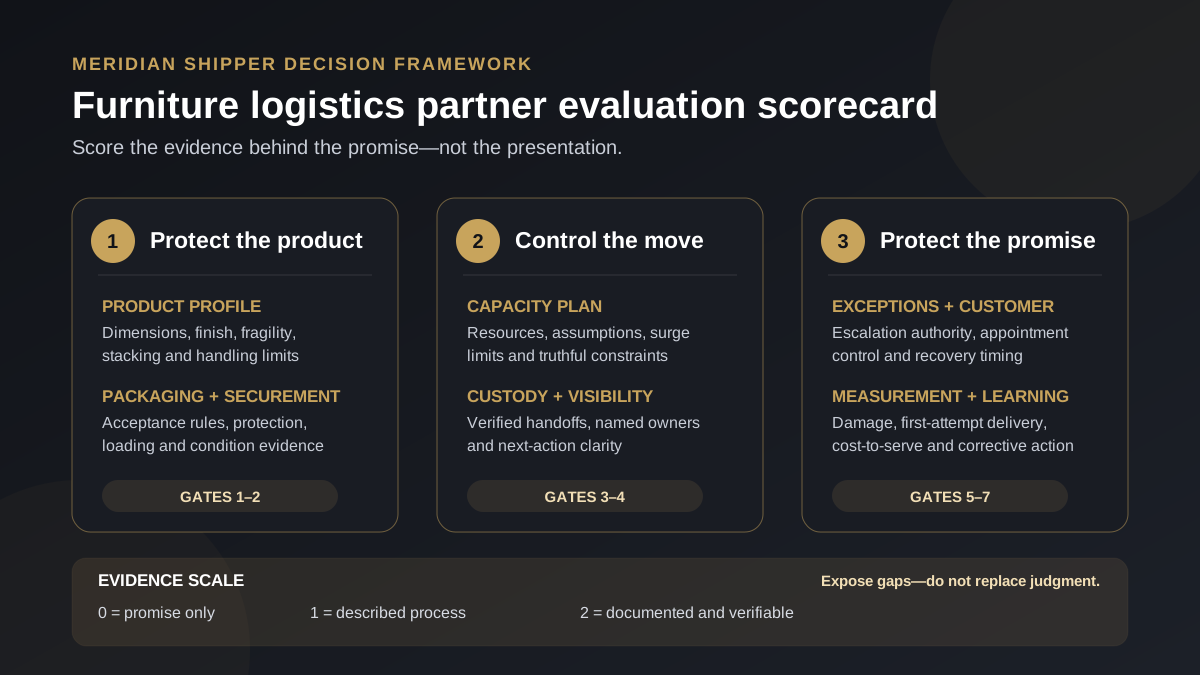
Seven gates for evaluating the provider
The questions below are designed to produce operational evidence, not a larger capability list.
1. Product knowledge changes the operating plan
Decision question: Can the provider translate the product profile into handling instructions before the first tender?
Evidence to request
- Product-level dimensions, weight distribution and stacking restrictions
- Finish, edge, glass, hardware and upholstery protection requirements
- Loading orientation, handling equipment and two-person requirements
- Pickup-rejection rules for packaging or condition defects
Warning sign: The provider describes furniture as ordinary dry freight and asks only for weight, pallet count and pickup date.
2. Packaging, loading and securement operate as one control
Decision question: Does the provider connect packaging condition, trailer condition, load configuration and securement evidence?
Evidence to request
- Written packaging and pickup-acceptance criteria
- Trailer inspection and cleanliness documentation
- Protection between pieces and control of movement in transit
- Origin photographs or other condition evidence when warranted
Warning sign: Damage review starts with the claim instead of the packaging, loading and custody evidence created before departure.
3. Capacity commitments include assumptions and limits
Decision question: What resources, lead times and geographic coverage support the provider’s volume commitment?
Evidence to request
- Forecast by lane, service, product and delivery requirement
- Normal and surge capacity with required notice
- Facility throughput and appointment constraints
- A defined response when the requested plan is not feasible
Warning sign: The proposal promises capacity without explaining equipment, labor, delivery coverage, notice or constraints.
4. Visibility explains the next action
Decision question: Will status information identify ownership, risk and the next decision—not merely a location?
Evidence to request
- Verified pickup, custody and appointment milestones
- Named owner for each material exception
- Next update time and customer-notification rule
- Recovery decision deadline before options disappear
Warning sign: The dashboard shows a status code, but nobody can state whether the customer promise is still achievable.
5. Exception authority is established before failure
Decision question: Who can approve recovery, alternate service, temporary storage or customer contact?
Evidence to request
- Severity-based escalation triggers
- Evidence required for damage and delivery exceptions
- Authority limits and after-hours contacts
- Customer-facing communication ownership
Warning sign: Every exception waits for an improvised chain of approvals while time-sensitive recovery options expire.
6. Delivery design protects the customer experience
Decision question: Does the operating plan reflect appointment, access, crew, equipment and handoff requirements at destination?
Evidence to request
- Confirmed service scope and delivery conditions
- Access, parking, dock, elevator and equipment requirements
- First-attempt delivery controls
- Proof of condition, delivery and customer communication
Warning sign: The transportation plan ends at arrival even though the brand promise depends on a successful handoff.
7. Performance reviews produce operating change
Decision question: Can the provider show how recurring evidence becomes a corrective action with an owner and due date?
Evidence to request
- Damage by product, lane, facility and handling point
- Pickup, delivery and first-attempt performance
- Exception response time, claims aging and avoidable accessorials
- Corrective-action validation before the issue is closed
Warning sign: Monthly reviews explain the same failures repeatedly but never change packaging, routing, training or handoff rules.
Make the scorecard part of the award
| Stage | Required output | Award decision |
|---|---|---|
| RFP | Written operating assumptions, evidence owners and unresolved gaps | Separate commercial promises from executable controls |
| Pilot | Representative products, lanes, facilities and delivery conditions | Verify the process under real operating conditions |
| Launch | Named owners, escalation rules, milestones and reporting cadence | Release freight only when evidence gaps have owners |
| Review | Root cause, corrective action, due date and validation result | Expand, correct or reduce the award based on performance |
Compliance is the floor
FMCSA’s general cargo-securement rules require cargo to be immobilized or secured with appropriate structures, dunnage, bracing, tiedowns or a combination. A furniture operating plan should explain how that requirement becomes repeatable loading and inspection practice.
Testing must match the product journey
ISTA Procedure 2C is a partial-simulation test for individually packaged furniture case goods. The relevant test, packaging and engineering decisions depend on the product, packaging configuration and actual distribution environment.
Frequently asked questions
Should a furniture brand choose the provider with the lowest rate?
Rate matters, but the comparison should include handling exposure, delivery scope, damage risk, redelivery, claims effort, accessorials and the business consequence of a failed customer promise. The lowest transportation line item can produce the highest cost to serve.
How should a shipper use the 0–2 evidence score?
Use it to identify where a proposal relies on promises. A zero means the provider has not described a process; one means the process is described; two means the process is documented and can be verified. The total is a discussion tool, not an automatic award rule.
What should be tested before a national award?
Test the operating design on representative products, lanes, facilities and customer requirements. Review pickup acceptance, condition evidence, appointment control, exception communication and recovery decisions—not just transit time.
How can Meridian help?
Meridian can help translate product characteristics, service requirements, delivery obligations and exception rules into a freight operating plan, then coordinate transportation and milestone ownership around that plan. Packaging engineering and site-specific safety decisions remain with qualified specialists and the shipper.
Sources and planning references
- International Safe Transit Association: Test Procedures — Procedure 2C furniture package description; accessed September 28, 2026.
- Federal Motor Carrier Safety Administration: Cargo Securement Rules — general securement requirements; accessed September 28, 2026.
- National Institute of Standards and Technology: Baldrige Criteria Commentary — supply-network, customer and operational-performance framework; accessed September 28, 2026.
This article provides general transportation-procurement information. Product-specific packaging, engineering, safety, legal and regulatory decisions belong to qualified specialists and the shipper.
Evaluating transportation for furniture or home furnishings?
Share the product profile, lanes, delivery requirements and customer commitments. Meridian can help translate those requirements into a practical freight plan and coordinated exception process.