Meridian Freight Insights
Carrier Liability, Cargo Insurance and Invoice Value: What Shippers Should Align Before Tender
A $250,000 invoice, a $100,000 cargo-insurance limit and a contract-based liability calculation are three different numbers. If the shipper does not reconcile them before pickup, the gap often becomes visible only after a loss.
The short answer
Do not use invoice value, declared value, carrier liability and insurance limit as interchangeable shorthand. Confirm the commercial value and risk owner, the governing transportation terms, the planned insurance response, the operational controls and the evidence path as one pre-tender decision. If the possible unrecovered loss is unacceptable, change the terms, coverage, service design or shipment configuration before release.
The most important number may be the gap
Shippers often ask whether a provider “has $100,000 in cargo insurance.” That is a reasonable screening question, but it cannot answer the business question by itself: how much of this specific loss could be recovered, from whom, under which terms, and on what evidence?
The starting values describe different things. Invoice value documents a commercial transaction. Carrier liability concerns the amount a carrier may owe under the governing legal and contractual framework. Cargo insurance concerns the policy response to covered loss, subject to policy terms. A shipper's own inland-marine or cargo coverage may protect a separate property interest. None automatically replaces the others.
One federal fact makes this distinction especially important. FMCSA says household-goods carriers and household-goods freight forwarders are required to carry cargo insurance, while the agency eliminated the federal cargo-insurance filing requirement for most other for-hire property carriers and freight forwarders. Active operating authority and public-liability filings therefore do not, by themselves, establish the amount or terms of cargo protection for a commercial shipment.
Align four layers before tender
The framework separates the values, then reconnects them through one release decision.
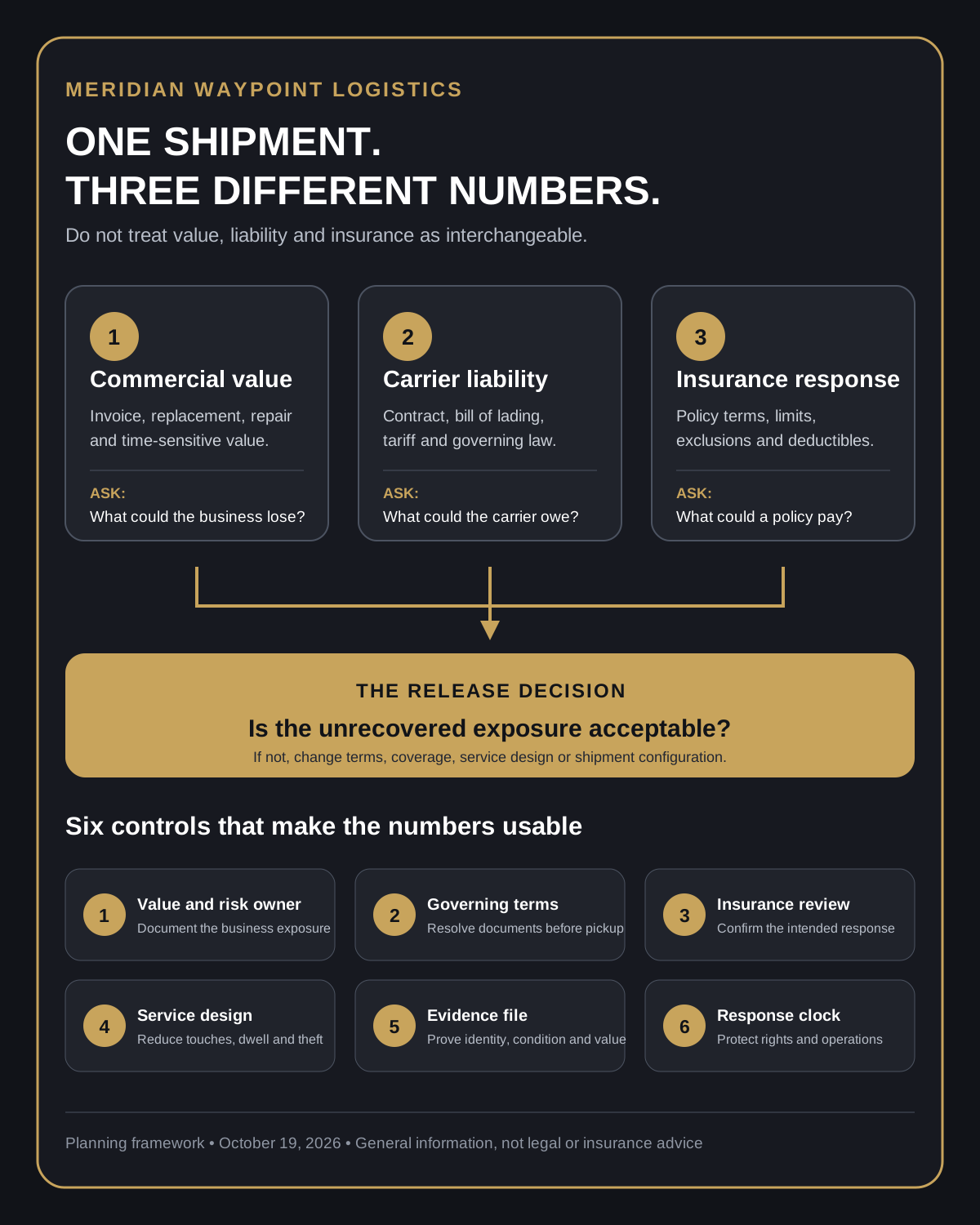
Six gates for a freight-value protection plan
Each gate should produce a documented answer that operations, procurement, finance and claims teams can use.
1. Establish the commercial value and who bears the loss
Start with the product and the transaction, not the carrier's policy limit. Record the quantity, unit value, total value, replacement or repair basis, and the point at which the commercial agreement shifts risk between seller and buyer.
- Identify the legal entity that owns the goods and has the financial interest in transit
- Separate invoice price from replacement cost, repair cost, lost margin and customer penalties
- Flag unusually high value per pound, theft-attractive goods and products with time-sensitive value
- Send questions about sales terms, title and risk of loss to qualified legal and insurance advisers
2. Read the transportation agreement before treating value as protected
The applicable agreement, bill of lading, rate confirmation, tariff and classification provisions can affect liability and claim handling. A value written in an internal order system does not automatically become the carrier's accepted liability.
- Confirm which contract and tariff terms govern the move
- Identify any released-value, per-pound, per-package, commodity or service-level limitation
- Verify how a declared value must be communicated and whether it changes the rate
- Escalate conflicting documents before pickup instead of trying to reconcile them after a loss
3. Verify the planned insurance response with the right specialist
Carrier liability and cargo insurance are related but different questions. Liability asks what the carrier may legally owe. Insurance asks whether a policy responds to that obligation or to the shipper's own property interest, subject to its terms, exclusions, deductibles and limits.
- Ask the shipper's insurance adviser whether owned goods are covered in transit and under what conditions
- Confirm shipment, vehicle, occurrence and aggregate limits where applicable
- Review exclusions, sublimits, deductibles, geographic scope and unattended-vehicle conditions
- Use certificates as evidence to investigate further—not as a substitute for policy and contract review
4. Match service design to the value exposure
Protection is operational as well as contractual. Extra touches, unsecured dwell, weak appointment control and unclear custody can create loss opportunities that no after-the-fact claim process can fully repair.
- Compare direct, team, expedited, LTL, consolidation and transload options by exposure as well as price
- Define secure parking, seal, tracking, check-call and route-deviation expectations when justified
- Limit unnecessary transfers and dwell for fragile, theft-attractive or deadline-sensitive freight
- Confirm origin and destination access, receiving authority and after-hours exception contacts
5. Build the evidence file before the trailer leaves
A claim investigation depends on shipment identity, condition, quantity, value and handling evidence. The most useful documentation is created at the moment each fact can still be observed.
- Retain the final bill of lading, rate confirmation, contract terms and applicable shipment instructions
- Capture counts, weights, serials, packaging, seals and clear origin-condition images
- Document exceptions at delivery before freight is moved, repaired, discarded or commingled
- Preserve invoices, repair estimates, inspection records, freight charges and mitigation activity
6. Give claims and operations one clock
Claims deadlines, customer obligations, salvage decisions and operational recovery often run on different timelines. A written response plan should preserve rights while the business also protects production, inventory and customer service.
- Name who gives notice, who files the written claim and who controls supporting records
- Record contractual filing periods instead of relying on memory or a standard assumption
- Separate replacement freight and customer recovery from the liability determination
- Track claim status, root cause and corrective action through final disposition
What each document can—and cannot—tell the shipper
| Record | Useful evidence | Question it does not answer alone |
|---|---|---|
| Commercial invoice | Product, quantity, transaction value and terms. | What the carrier legally owes after a covered loss. |
| Bill of lading | Shipment receipt, description and incorporated terms. | Whether every separate agreement, tariff or policy will respond as expected. |
| Rate confirmation or contract | Agreed service, price, parties and negotiated obligations. | Whether the product and operating facts satisfy all insurance conditions. |
| Certificate of insurance | A point-in-time summary to support further verification. | Coverage for this loss, final policy terms or accepted legal liability. |
| Origin and delivery evidence | Observed quantity, condition, seals, custody and exceptions. | The governing valuation or liability rule. |
Liability is not a policy limit
The Carmack Amendment establishes a federal liability framework for many interstate motor-carrier and freight-forwarder shipments, but contracts, released rates, commodity provisions, exceptions, facts and other legal rules matter. Treat the applicable terms as a legal review, not an operations assumption.
Evidence has to prove more than value
49 CFR Part 370 governs motor-carrier and freight-forwarder claim processing. The rules contemplate written claims and supporting records such as bills of lading, freight-charge evidence and invoices or other proof of value when needed. Build that file while facts are observable.
Use a written release brief for elevated-value freight
- Owner and commercial value
- Value per shipment and per pound
- Governing contract and tariff
- Accepted declared or released value
- Carrier and shipper insurance review
- Exclusions, deductibles and sublimits
- Mode, transfers and dwell points
- Packaging and load securement
- Tracking, seals and parking rules
- Origin and delivery evidence
- Exception and theft contacts
- Claim notice and filing owners
Frequently asked questions
Does a carrier's cargo-insurance limit guarantee payment up to that amount?
No. A stated policy limit is not a guarantee that a particular loss is covered or that the carrier is liable for the full commercial value. Contract terms, applicable law, policy wording, exclusions, deductibles, facts and evidence all matter. Shippers should review the intended protection with qualified legal and insurance advisers.
Is the invoice value automatically the carrier's liability?
Not automatically. The invoice can help establish product value during a claim investigation, but liability can be affected by the governing transportation agreement, bill of lading, released-value or commodity provisions, service terms and applicable law.
Does FMCSA require every interstate property carrier to file cargo insurance?
No. FMCSA states that household-goods carriers and household-goods freight forwarders must maintain cargo insurance filings. The agency removed the federal cargo-insurance filing requirement for most other for-hire property carriers and freight forwarders in 2011. Shippers still need an appropriate risk and insurance review for their freight.
What should a high-value shipment review contain?
At minimum: product identity, quantity, weight, commercial value, value per pound, governing terms, accepted liability, insurance review, packaging, handling, mode, transfer points, dwell, security controls, tracking, delivery authority, evidence standards and escalation contacts.
How can Meridian support this process?
Meridian can help translate the shipment's value, physical characteristics, facilities, timing and service requirements into transportation options and a documented operating plan. Legal advice, insurance placement, coverage interpretation and final claim determinations remain with qualified advisers, insurers and the parties to the governing agreements.
Sources and planning references
- Federal Motor Carrier Safety Administration: Insurance Filing Requirements — federal filing requirements by authority and cargo type; accessed October 19, 2026.
- FMCSA: Cargo Insurance for Property Loss or Damage — final rule removing the federal cargo-insurance filing requirement for most non-household-goods property carriers and freight forwarders; accessed October 19, 2026.
- 49 CFR Part 370 — federal motor-carrier and freight-forwarder claim-processing principles; accessed October 19, 2026.
- 49 U.S.C. § 14706 — statutory text for carrier and freight-forwarder liability under receipts and bills of lading; accessed October 19, 2026.
- NMFTA Freight Classification Docket 2026-1 Disposition Bulletin — current examples of commodity-specific value declarations and limitations; accessed October 19, 2026.
This article provides general transportation-planning information, not legal advice, insurance advice or a coverage opinion. Contracts, tariffs, classifications, policies, facts and governing law vary. Shippers should have qualified legal and insurance professionals review their specific arrangements.
Meridian Waypoint Logistics
Turn the value review into an executable shipment plan
Share the commodity, value, dimensions, packaging, facilities, delivery obligation, service requirements and known risk controls. Meridian can help compare available transportation options and build the operating brief around the shipment's actual exposure—while your legal and insurance advisers address contract and coverage decisions.