Meridian Freight Insights
Detention, Layover, TONU and Redelivery: How Shippers Can Control Accessorial Exposure
Most accessorial disputes do not begin with a fee. They begin when the operating timeline and the commercial terms describe different versions of what was supposed to happen.
The short answer
Treat accessorial control as a timeline-ownership problem. Before dispatch, define the planned events, commercial triggers, free time, evidence standard and decision owners. During the move, capture the actual timestamps and escalate before the agreed threshold. Afterward, reconcile one evidence packet against the agreed rule. A lower linehaul rate does not offset a plan that leaves those decisions undefined.
One delay can create four different commercial questions
A shipment canceled after a truck is dispatched, a driver waiting at the gate, a dock delay that eliminates same-day delivery, and a receiver that refuses the first attempt are not the same event. They may lead to truck-ordered-not-used, detention, layover or redelivery discussions, but the label should follow the facts and the agreed terms—not replace them.
The operating consequence can be larger than the elapsed minutes. Under 49 CFR 395.2, loading, unloading, attending the vehicle and certain waiting time can count as on-duty time. For most property-carrying operations subject to the standard rule, 49 CFR 395.3 limits driving to an 11-hour total within a 14-hour period after the required off-duty time. A dock delay can therefore change whether the original delivery plan remains legally and operationally feasible.
FMCSA research has long treated detention as both an operating and safety problem. Its Phase II research page reports that a prior study associated longer-than-expected loading time with fatigue and that surveyed drivers attributed about 18 percent of work time to schedule delays from long waits. The shipper's practical response is not to assume that every wait is billable; it is to make each event measurable and each decision timely.
Build one clock from request to delivery outcome
Each timestamp answers a different question. The commercial result still depends on the parties' agreement.
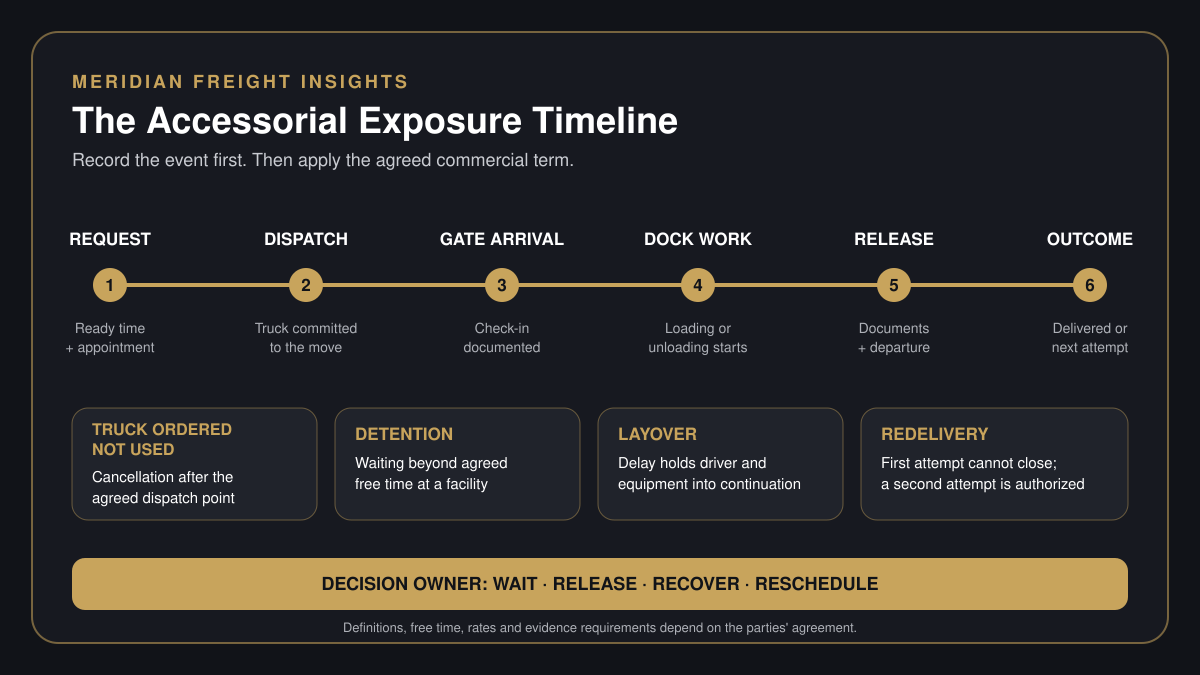
Six control points for accessorial exposure
The objective is not to preapprove every fee. It is to give operations enough information and authority to avoid preventable delay and resolve unavoidable events with evidence.
1. Lock the operating promise before requesting a truck
Start with the shipment's real facility and customer constraints. The transportation request should state when the freight will be ready, whether an appointment is confirmed, what equipment and driver assistance are required, and when the site can actually receive the vehicle.
- Use the facility's local time zone and distinguish appointment time from shipping-hours range
- Confirm freight count, dimensions, weight, packaging and documents before dispatch
- Identify first-come-first-served locations, appointment-only sites and drop-trailer programs
- Name the origin and destination contacts who can make an operating decision
2. Put the accessorial terms beside the operating plan
Detention, layover, truck-ordered-not-used and redelivery are commercial terms, not universal labels with one industrywide trigger. Record the agreed definition, free time, rate or fee, required notice, evidence and approval path for the specific movement.
- Define when the clock starts, pauses and ends at each facility
- State whether early arrival, missed appointments or driver-assist work change the calculation
- Document cancellation cutoffs and what counts as dispatch
- Clarify who may authorize waiting, rescheduling, recovery service or a second attempt
3. Capture gate arrival separately from service start
A single 'arrived' timestamp hides the operating cause. Preserve the appointment, geofenced arrival, gate check-in, dock assignment and active loading or unloading times as separate events so the parties can see where the queue formed.
- Ask the driver to use the facility's required check-in channel and retain confirmation
- Record rejection at the gate, staging instructions and dock assignment changes
- Note whether the freight, paperwork, labor, dock or receiving authorization was unavailable
- Keep arrival and departure records in the shipment file, not only in an informal message thread
4. Escalate before free time expires
The first useful alert is not the invoice. Establish a warning point early enough for the shipper, broker, carrier and facility to act—move the truck to a dock, correct paperwork, approve continued waiting or protect the delivery plan.
- Send a time-stamped warning to the named decision owner
- State the current delay, the approaching threshold and the downstream commitment at risk
- Request a clear wait, recover, reschedule or release decision
- Update the destination when origin delay changes the expected arrival
5. Re-plan when dwell changes legal or feasible service
Waiting can consume a driver's available work window even when the shipment has not moved. The recovery decision should use the driver's actual available hours, remaining distance, parking options, appointment rules and service commitments—not the original schedule copied forward.
- Recalculate feasible transit and delivery after material dwell
- Do not pressure a driver or carrier to exceed hours-of-service requirements
- Compare rescheduling, relay, team service, recovery capacity or secured hold only when operationally justified
- Tell the customer what changed, what is known and which decision is needed
6. Close the event with one evidence packet
Resolve the shipment record before the parties' memories diverge. The closeout should reconcile agreed terms with the event timeline, notices, facility records, driver documentation, proof of delivery and any mitigation work.
- Keep the tender, rate confirmation, appointment, arrival, dock and release records together
- Separate undisputed transportation charges from any questioned accessorial item
- Identify the operational root cause without assuming that every delay supports a charge
- Use repeated events to change facility instructions, tender timing or service design
Use the charge name to ask the right operating question
| Commercial term | Operating question | Evidence to preserve |
|---|---|---|
| Detention | Did waiting exceed the agreed free time, and why? | Appointment, arrival, check-in, dock-start, completion, release and notices. |
| Layover | Did the delay hold the driver and equipment beyond the planned operating period? | Delay timeline, available hours, instructions, reschedule and continuation record. |
| Truck ordered not used | Was the truck dispatched before the shipment was canceled or found unavailable under the agreed rule? | Tender acceptance, dispatch, cancellation time, distance and shipper notice. |
| Redelivery | Why could the first delivery not be completed, and who authorized the next attempt? | Arrival, refusal reason, receiver record, freight custody, new appointment and instructions. |
The first alert should protect an option
A notice sent after free time has expired mostly documents cost. A warning sent early enough to move the truck, correct documents, approve waiting or reschedule delivery can still protect the shipment.
A timestamp needs a source
Keep the appointment record, driver check-in, geofence or ELD event where appropriate, facility record, message history and signed documents. One unsupported time in a spreadsheet is weaker than a reconciled event trail.
Tender checklist
- Freight-ready date and time
- Confirmed appointment or hours
- Facility time zone and check-in
- Equipment and driver-assist needs
- Accessorial definitions and free time
- Rates, caps and approval authority
- Cancellation cutoff and dispatch rule
- Required notice and evidence
- Origin and destination contacts
- Driver hours and transit feasibility
- Wait, recover or release owner
- Customer update responsibility
Frequently asked questions
When does detention start?
There is no single answer for every shipment. The applicable agreement should define the event that starts the clock, the amount of free time, any exclusions, the notice requirement and the evidence needed. Operationally, preserve appointment, arrival, check-in, dock-start and release timestamps so the agreed rule can be applied to facts.
What is the difference between detention and layover?
In common transportation usage, detention addresses excess waiting at a facility, while layover often describes a delay that holds the driver and equipment beyond the planned operating day or requires a later continuation. The governing agreement may define them differently, so shippers should avoid treating the labels as self-executing.
What is truck-ordered-not-used?
Truck-ordered-not-used, often shortened to TONU, generally refers to compensation requested when a truck was ordered and the shipment was canceled or unavailable after an agreed dispatch or cancellation point. The triggering event, amount and proof depend on the parties' terms.
How can a shipper reduce redelivery exposure?
Confirm the delivery appointment, receiver hours, purchase-order status, unloading method, count and packaging requirements, driver instructions and after-hours authority before dispatch. If the first attempt fails, document why, protect the freight and obtain written direction before a second attempt.
How can Meridian help?
Meridian can help turn facility rules, shipment readiness, appointment requirements, transit constraints and escalation contacts into a documented transportation plan. The shipper and its advisers remain responsible for approving commercial terms and resolving contractual questions.
Sources and planning references
- 49 CFR 395.2 — definition of on-duty time, including specified waiting, loading, unloading and shipment-receipt activity; accessed October 26, 2026.
- 49 CFR 395.3 — maximum driving time rules for property-carrying commercial motor vehicles; accessed October 26, 2026.
- FMCSA: Impact of Driver Detention Times on Safety and Operations, Phase II — federal research background on waiting time, fatigue, operations and hours-of-service risk; accessed October 26, 2026.
- American Transportation Research Institute: Costs and Consequences of Truck Driver Detention — 2024 industry research on detention frequency, cost and facility practices; accessed October 26, 2026.
This article provides general transportation-planning information, not legal advice or a determination that any fee is owed. Accessorial definitions, triggers, amounts, evidence requirements and dispute procedures depend on the parties' agreements and the facts of the shipment.
Meridian Waypoint Logistics
Put the operating clock into the transportation plan
Share the freight-ready time, facilities, appointments, equipment, delivery commitment and accessorial terms. Meridian can help build a documented movement plan, coordinate the handoffs and escalate exceptions before preventable waiting becomes a larger service failure.